
 400 606 5609
Experience DEMO
400 606 5609
Experience DEMO
400 606 5609
Experience DEMO
400 606 5609
Experience DEMO

China Minsheng Bank, established in 1996, is a nationwide joint-stock commercial bank. It was listed on the Shanghai Stock Exchange in 2000 and the Hong Kong Stock Exchange in 2009. As a Fortune Global 500 company, Minsheng Bank has achieved rapid growth despite fierce competition within the industry. This success is closely tied to its top-down commitment to a digital transformation strategy.

“Data is one of the most critical assets for banks, serving as the foundation for refined management, differentiated services, business innovation, and enhanced risk analysis capabilities. As the saying goes, "To do a good job, one must first sharpen their tools." To accelerate its digital transformation, China Minsheng Bank, building on its existing data infrastructure, has adopted a business-driven approach and prioritized data application effectiveness to develop a data middle platform that is both practical and user-friendly. With real-time, intelligent analytics at its core, the bank leverages data and models to drive financial product and service innovation, providing rapid, end-to-end business support, empowering scenarios, and directly engaging customers. The successful deployment of DataPipeline’s enterprise-grade real-time data synchronization platform at Minsheng Bank has effectively met our requirements in terms of accurate real-time synchronization of heterogeneous data, system stability, ease of use, and security. It has enabled enterprise-level real-time data collection, integration, and synchronization, laying a solid foundation for the bank’s middle-platform strategy. At the same time, the platform has significantly reduced manual development costs and accelerated the realization of real-time data value. Looking ahead, both parties will explore broader data management scenarios and work together to promote more real-time application deployments.”

The setup of the development environment and the learning of the development language are quite challenging, involving multiple distributed technology components. The process of code development and component optimization is also very difficult.
There are numerous configuration files and parameters for associated components, along with a large number of job environment settings and configuration variables. However, the limited availability of validation environments increases the risk of production issues caused by configuration or environment-related errors.
Error and exception data are difficult to trace, and business monitoring and task status monitoring for real-time jobs are relatively challenging to implement using the bank's existing traditional monitoring systems.
The real-time data on customer behavior is standardized and completed, and then distributed to various application systems.
The real-time account changes and indicator variations of the business system are transmitted to GaussDB as the basis for calculating real-time positions.
Real-time data is loaded into Redis for use in real-time business queries.
The master data system data and the data warehouse data are loaded into SequoiaDB for use as historical data for querying.
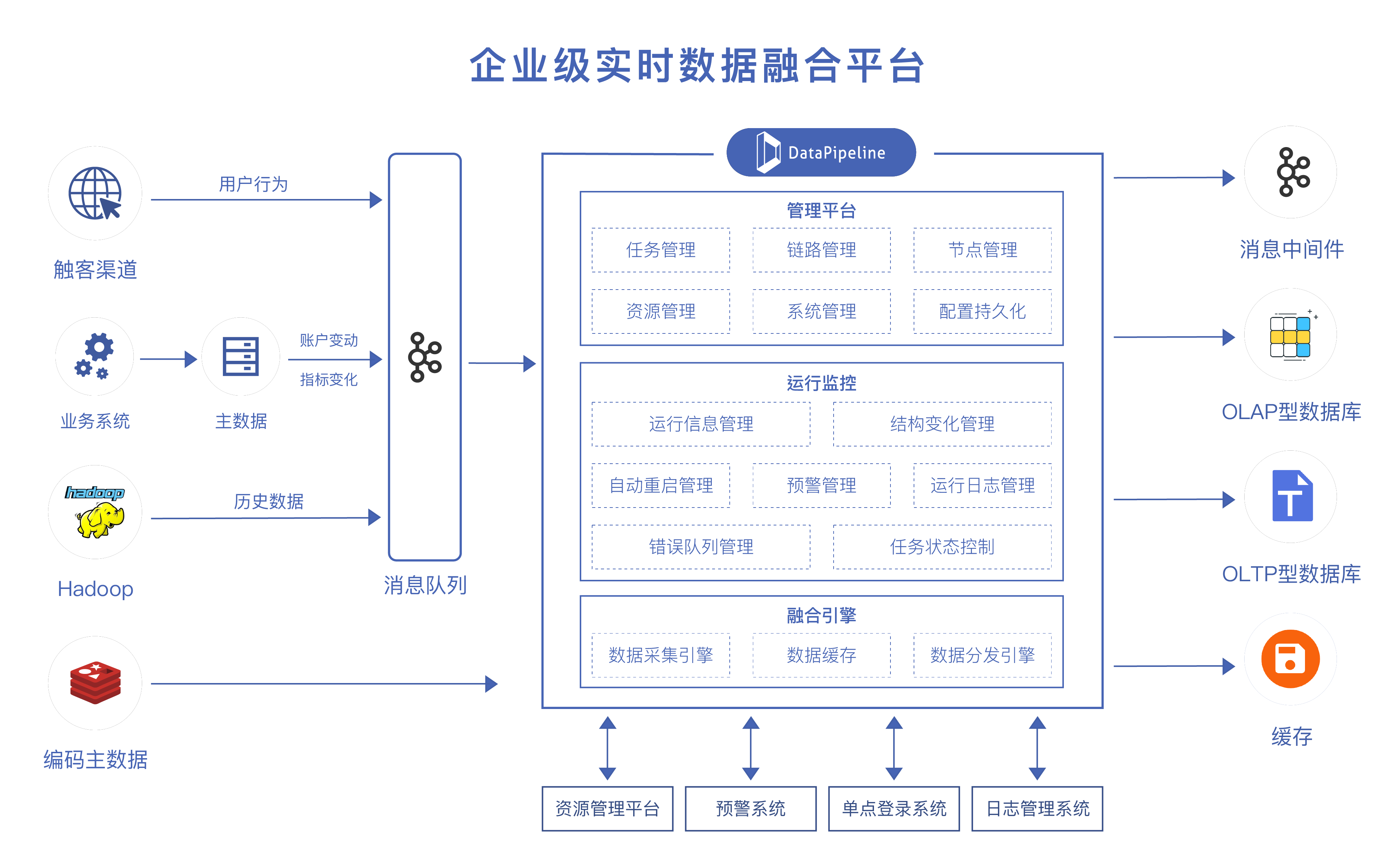

Support real-time inquiries for both customers and regulators. Improve the query performance of the data center's query module and reduce storage costs.

The one-to-many data distribution link can effectively handle various real-time data application scenarios and enhance the reusability of data.

DataPipeline is simple and easy to use, significantly accelerating the development, configuration, and deployment of real-time data synchronization tasks. The collection and processing of real-time data can be fully achieved through configuration, eliminating the drawbacks of traditional project-based delivery. With DataPipeline, China Minsheng Bank no longer needs to use Spark Streaming for real-time data transmission development, which reduces manual development costs and speeds up the realization of real-time data value.

